Term 1 Week 2
In This Newsletter
A Message From Our Director
Charting the Course - Learning intent for the week, QIP highlight etc
Grow With Us…
This quarter our focus for growth and improvement is in Quality Area 6: Collaborative Partnerships with Families and Communities. At CCC ELC, this involves building Community & Connection - between educators and children, with our ELC families, and with our wider Gympie community.
We are excited to announce that Emily Howell has stepped into the role of Community Collaborator. Emily will be forming networks and developing relationships with businesses in our local community, to enrich children's learning opportunities and to best support you, our ELC families.
At CCC ELC, we value and recognise the rich contributions parents and families can make to their children's learning. If you:
- have a small business
- would like to share your profession, occupation or skills
- feel you have something to contribute to our Early Learning Centre
please contact Emily at [email protected].
Important Information
Items to bring every day
Items to Bring Every Day - ALL labelled with your child's name:
- Cot-sized sheet x2
- Hat
- Water bottle
- 3 sets of spare clothes and small towel (hand towel size)
Tuckshop can be ordered through the Flexischools app. Download the app and follow the prompts.
Annual Enrolment Forms
We have a number of Annual Enrolment Update Forms, Regular Outings Forms and Child Profiles outstanding. It is important to return these promptly, so that your child can participate in incursions within the school grounds. If you require a copy of any of these forms, please ask your child's Room Leader. Copies are available in each room or at front administration desk upon request.
Weekly Memory Verse
Weekly Memory Verse
"I praise you because I am fearfully and wonderfully made." - Psalm 139:14
Cooking Experience with Ms. T
Chocolate Cake
Ingredients
Cake:
-
270 g brown sugar (≈ 1⅓ cups)
-
185 ml milk (¾ cup)
-
125 g butter, cubed
-
50 g cocoa powder (½ cup)
-
¼ tsp baking soda
-
150 g self-raising flour (1 cup)
-
2 tbsp plain flour
-
3 eggs, lightly whisked
-
Melted butter (for greasing)
Chocolate icing:
-
195 g pure icing sugar (≈ 1¼ cups)
-
1 tbsp cocoa powder
-
10 g (2 tsp) butter, softened
-
6–8 tsp boiling water
Method (Simple Steps)
-
Heat oven & prep pan:
Preheat oven to 160 °C. Grease a deep square or round cake pan (≈19 cm base) with melted butter and line with baking paper. -
Mix wet cake ingredients:
In a large saucepan, combine brown sugar, milk and cubed butter. Sift cocoa powder and baking soda over the top. Warm gently over low heat, whisking until smooth (don’t boil). -
Add dry & eggs:
Remove from heat. Stir in the self-raising flour and plain flour, then mix in the lightly whisked eggs until just combined. -
Bake:
Pour batter into prepared pan. Bake for about 45–60 minutes, until a skewer inserted in the centre comes out clean. Leave to cool in pan for a few minutes, then transfer to a cooling rack. -
Make the icing:
In a bowl, sift together icing sugar and cocoa. Add the soft butter and mix. Add boiling water a teaspoon at a time until you reach a smooth, spreadable icing. -
Ice & enjoy:
Spread icing over the cooled cake. Cut into squares and serve!
Interesting Learning
Blooms
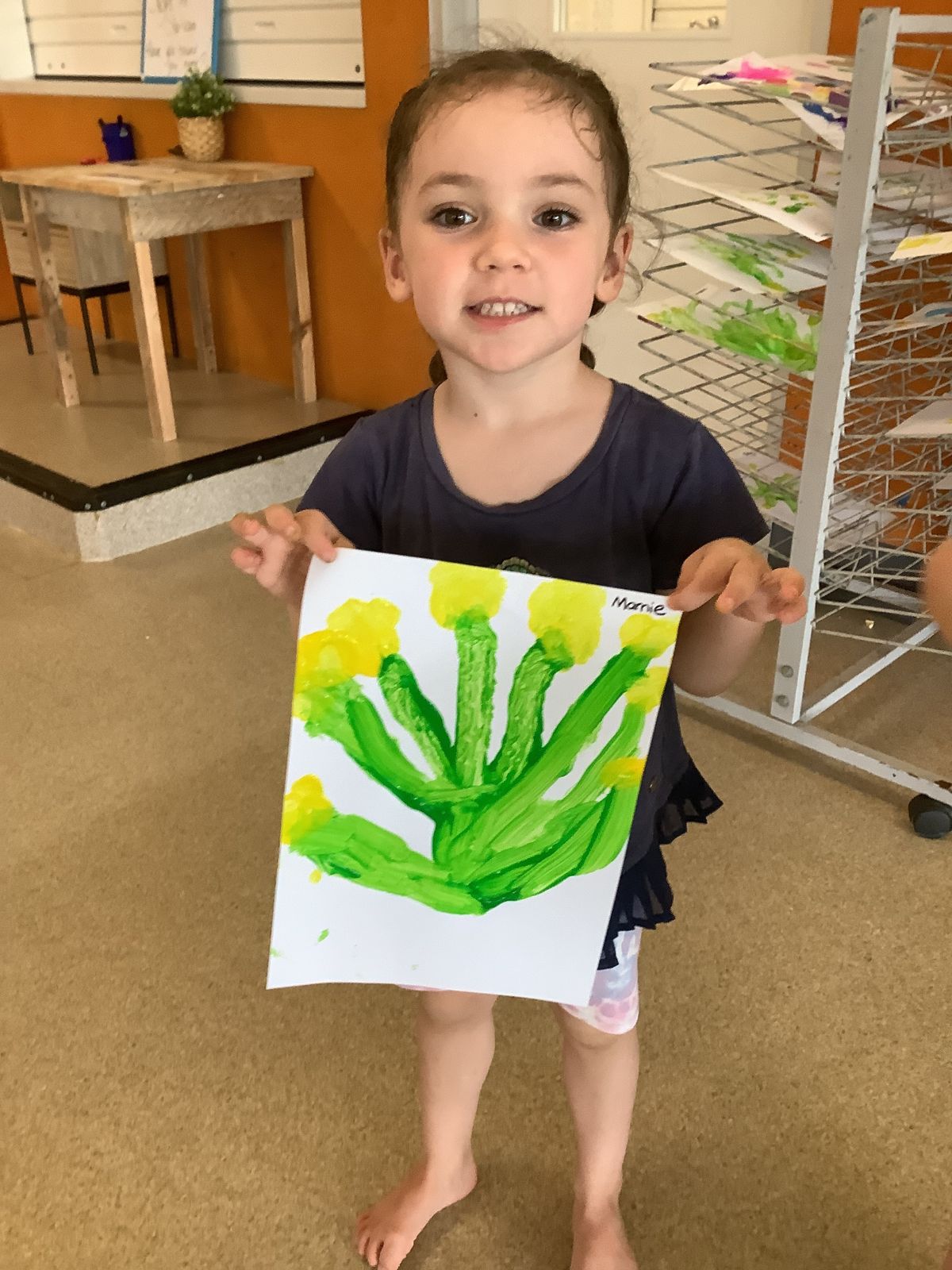
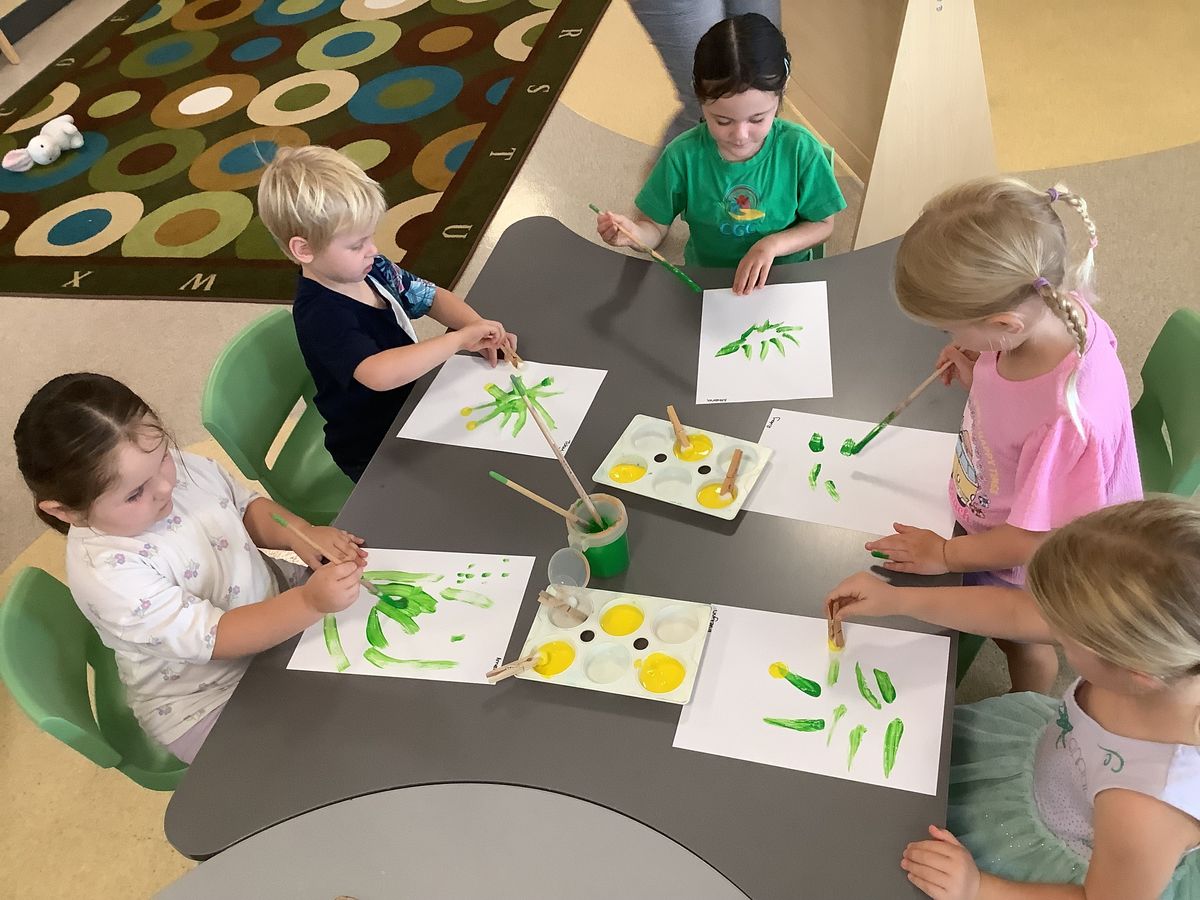
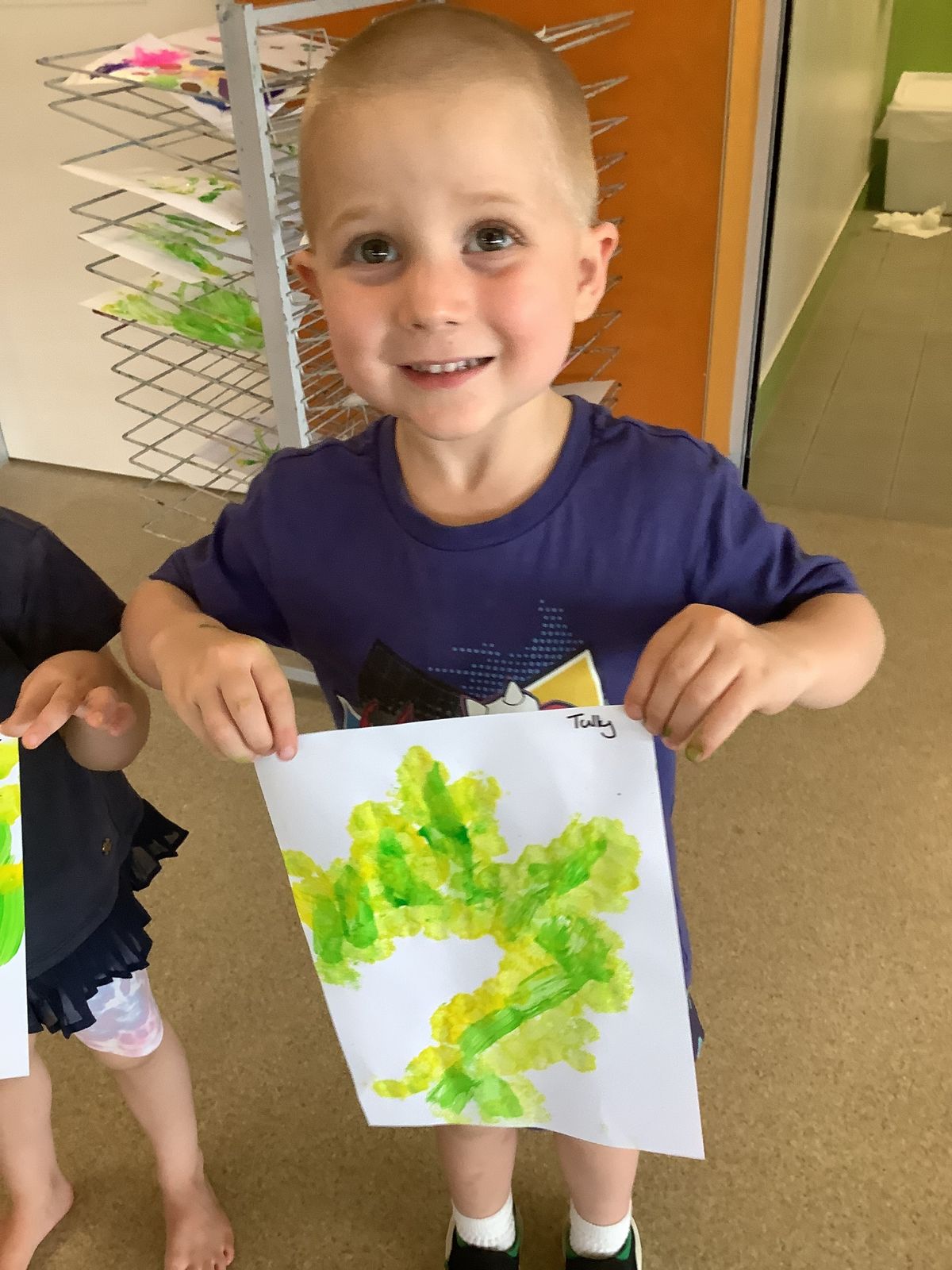
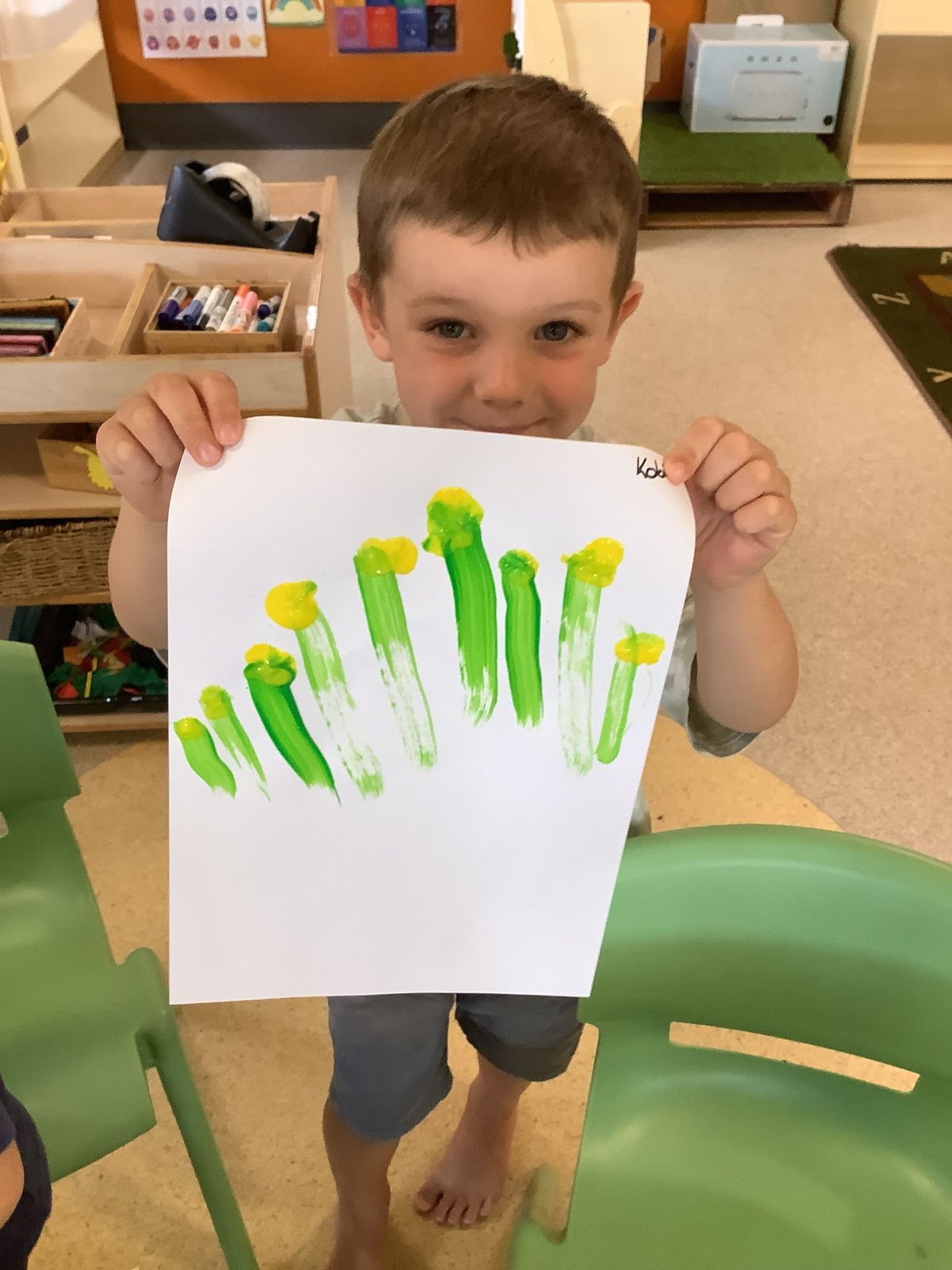
Learning Story: Blooming bright for Australia Day! 💛🌿
To celebrate Australia Day, and to extend on our current interest in flowers, the children explored our national flower, the Golden Wattle, through a fun and creative painting activity. Using a leaf stamping technique, the children printed long green leaves, then challenged their fine motor skills by using tweezers and dabbing pom poms to create fluffy yellow blossoms. Each child proudly created their own wattle tree artwork, focusing on the bright colours and unique features of this iconic Australian plant. Through this experience, children developed hand–eye coordination, grip strength, and bilateral control. They also practiced concentration and persistence as they carefully placed their flowers, explored sensory textures, and engaged in early creative decision-making such as colour choice and placement. Opportunities to talk about their artwork supported language development and confidence, while learning about the Golden Wattle encouraged a growing appreciation for Australian nature, Australian symbols and cultural identity.
We loved seeing the children’s creativity bloom as bright as our beautiful wattle trees!
Parent Resources & Information
Why boredom is actually good for young children
In today’s fast-paced world, boredom can feel uncomfortable for children and adults alike. With busy schedules, extracurricular activities and screens always within reach, moments of “nothing to do” are becoming increasingly rare. When a child says, “I’m bored,” it’s tempting to step in straight away with an activity, a suggestion, or a device. However, boredom is not something to fear or fix. In fact, it plays an important role in children’s learning and development.
Boredom gives children the time and space to think, imagine, and explore at their own pace. Without constant stimulation, children begin to look inward for ideas and outward for possibilities. This is often when creativity flourishes. A cushion becomes a mountain, a cardboard box becomes a rocket ship, and a stick becomes a magic wand. These moments of imaginative play help children develop problem-solving skills, flexible thinking, and confidence in their own ideas. Unstructured time also supports independence. When children are not directed by adults or scheduled activities, they learn to make choices for themselves. They practise deciding what to do, how to do it, and how to keep themselves engaged. These small decisions build a sense of autonomy and capability, helping children feel confident in navigating both play and everyday life.
At home, allowing space for boredom may feel challenging at first. Adults often worry that children need to be constantly entertained or productively occupied. However, children do not need expensive toys or planned activities to learn. Simple, open-ended materials are often the most powerful tools for play. Blocks, dress-ups, recycled materials, loose parts, art supplies, and everyday household items invite children to explore freely and creatively. These materials encourage experimentation and imagination rather than a “right” or “wrong” way to play.
Time spent outdoors can also transform boredom into meaningful learning. Nature offers endless opportunities for discovery, watching ants carry food, collecting leaves, splashing in puddles, or building cubby houses from sticks. Outdoor play supports physical development, curiosity, and connection to the natural world. It also allows children to experience change, risk-taking, and problem-solving in a real and engaging environment.
Boredom plays an important role in emotional development as well. Feeling bored can bring up emotions such as frustration, restlessness, or disappointment. Learning how to sit with these feelings and work through them helps children develop emotional regulation and resilience. Over time, children begin to understand that uncomfortable feelings pass and that they have the ability to find solutions for themselves. These builds coping skills that are essential for school and life beyond the early years.
It’s also important to consider the role of screens in children’s experience of boredom. While digital devices can be entertaining and educational in moderation, constant access to screens can reduce opportunities for deep, imaginative play. When children are used to instant entertainment, boredom may feel more difficult to manage. Creating regular screen-free time allows children to rediscover the joy of play, creativity, and exploration without external stimulation.
In early education and care services, we value play that is child-led, open-ended, and rich in learning opportunities. Educators intentionally create environments that allow children to explore their interests, follow their curiosity, and engage in sustained play. By allowing similar opportunities at home, families can support continuity between preschool and home life, reinforcing the skills children are developing each day.
Embracing boredom does not mean leaving children unsupported. It means being present, observant, and responsive while allowing children the freedom to lead their own play. Sometimes this involves stepping back rather than stepping in trusting that children are capable of finding their own way. Over time, families often notice that children become more creative, more independent, and more confident when given space to simply be.
So next time boredom appears, try pausing before offering a solution. What may feel like “nothing happening” is often the beginning of something meaningful. In the quiet moments, children are learning, growing, and discovering who they are.
Please leave a review
If you have time, would you be willing to leave a positive online review for the CCC Early Learning Centre? It should only take a moment if you click the button below. You can simply leave a rating however we’d love you to share details of your positive experience. Thank you in advance for helping us celebrate the ELC.